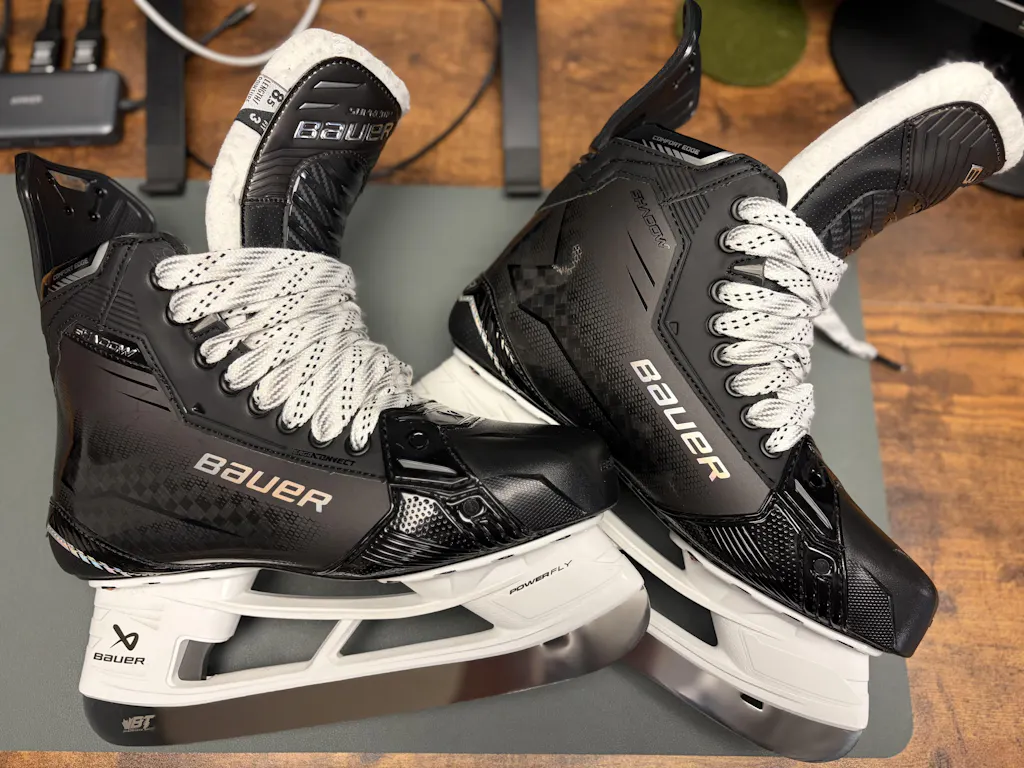
Sharpening 101 covered the cut across your steel. This course covers the shape along it — the rocker, the pitch, and the platform you balance on every second you’re on the ice. Short lectures with diagrams up front. Full deep-dives underneath. This is the part of skate tuning most players never learn — and the one the pros obsess over.
The Dude’s one-sentence truth: a profile is not a magic number — it’s a balance and contact strategy. You already have one (the factory picked it without meeting you). The only question is whether it’s helping you or forcing you to compensate.
Start Here (60 seconds)
Tap your situation. You’ll get a fast answer and a pointer to the right lecture.
How this course works: bite-size lecture and diagram first, “Go Deeper” drawers underneath with the full data. Take Sharpening 101 first if you haven’t — the two courses share one blade.
U1
Unit One
The Concept
The dimension of your steel nobody told you about — lectures 1–2
1) The Other Dimension of Your Steel
Sharpening is the cut across the blade. Profiling is the shape along it. Different dimension, different job, different feel.
Sharpening shapes the hollow between your two edges: bite versus glide. Profiling shapes the curve from heel to toe: balance, contact, and where your weight lives. Players mix them up constantly — and chase a new hollow when the real problem is the platform underneath them.
What profiling can do: change your balance, stability, toe-engagement timing, transition feel, glide efficiency, and confidence under fatigue. What it can’t do: replace knee bend, edge skill, mobility, strength, or habits. It’s tuning — not a shortcut.
Go Deeper: Why the Two Systems Get Confused — and the One Rule That Untangles Them
Both live on the same 3mm of steel, both are changed by a person with a grinding wheel, and both alter how your skate “feels.” But they answer different questions. Hollow: how hard do my edges grip when I lean? Profile: where is my weight, and how much blade is under it?
The confusion has a cost. A skater whose profile has drifted feels “off,” asks for a different hollow, feels different-but-still-wrong, changes hollow again — and ends up three changes deep with no idea what did what. Meanwhile the actual problem was the platform.
The Dude Rule: never change profile and sharpening at the same time while testing. Bauer’s own profiling guidance says the same thing — isolate one variable so you know what actually helped. Lock your hollow, change the profile, test it clean. One lever at a time is the entire discipline.
2) The Rocker: Your Blade Is a Slice of a Giant Wheel
Hollow circles are measured in inches. Rocker circles are measured in feet.
Seen from the side, your blade’s bottom is the lowest arc of an enormous circle — most stock player steel is cut to a 9' or 10' radius. You never stand on the whole blade. You stand on a short contact patch where that arc meets the ice, and you steer your entire game by rolling along it. Bigger radius = flatter blade = longer patch. Smaller radius = rounder blade = shorter patch.
The number that should blow your mind (part two): contact length grows with the square root of the radius — so going from a 9' to a 13' profile puts about 20% more steel on the ice. A goalie’s 30' profile carries about 80% more than your 9'. Same blade length, completely different sport underfoot.
Go Deeper: The Contact-Patch Math
The formula. When a curved blade presses a small depth d into the ice, the loaded contact length is approximately L = 2√(2Rd). The exact length depends on your weight and the ice (that’s d), but the ratios between radii don’t — contact scales with √R for the same skater on the same ice. Indexed against a stock 9' profile:
7' radius≈ 88% of stock contact — quickest pivots, least support
9' radius100% — the stock-steel reference point
10–11' radius≈ 105–111% — noticeably calmer glide
13' radius≈ 120% — long-contact stability (and the youth-skate trap in lecture 8)
28–30' (goalie)≈ 175–183% — a different discipline entirely (lecture 10)
Why a few millimeters matter so much. Your contact patch is on the order of an inch or two long. A profile change moves that by a few millimeters — a 10–20% change to the entire platform your balance system is standing on. Tiny absolute numbers, enormous proprioceptive difference. This is also why “I can’t describe it, it just feels different” is a completely legitimate profiling review.
One more variable players forget: steel height. As your runner wears down from sharpenings, you lose leverage and the same profile sits differently. A profile evaluation always starts with how much steel you have left — sometimes the honest answer is “new steel first.”
U2
Unit Two
The Tradeoff
The four zones of the blade, and the hidden variable called pitch — lectures 3–4
3) The Four Zones: What Each Part of the Blade Does
The fundamental tradeoff: agility lives at the toe, stability lives at the heel — and a single radius forces you to choose.
Skate engineers break the blade into working zones: the toe drives acceleration, the front-middle handles transition (pivots, direction changes), the back-middle carries speed (stride glide), and the heel anchors stability. Profiling decides how much steel each zone gets — and where your balance point sits among them.
Go Deeper: How the Tradeoff Actually Plays Out
Flatter (bigger radius): more contact → more speed, more stability, calmer balance at pace, more efficient long strides. The cost: slower to initiate turns, heavier-feeling pivots, lazier first steps.
Rounder (smaller radius): shorter contact → quicker pivots, snappier acceleration, easier tight turns. The cost: less support at speed, twitchier balance, more work to stay calm in straight lines.
Weight matters here too. A heavier player loads the patch deeper (more effective contact) and can afford a rounder profile without feeling twitchy; a light player on the same shape may feel like they’re balancing on a marble. Same logic as hollows in Sharpening 101 — pressure changes everything.
And this is why combination profiles exist. A single radius gives all four zones the same curve — one compromise stretched across four jobs. Multi-radius profiles (lecture 6) give the toe a quick curve and the heel a stable one, so you stop choosing. That’s the entire premise of modern profiling.
4) Pitch & Balance Point: The Hidden Variable
Two skaters try the “same profile” and write opposite reviews. Pitch is usually why.
Pitch is where the profile biases you to stand — neutral, forward, or back. A forward pitch nudges your weight onto the balls of your feet: deeper knee bend, quicker toe access, snappier starts. Too much, and you’re fighting your own skates — burning calves, falling onto your toes. Backward bias calms everything down and stabilizes the heel — overdo it and you feel glued to the ice with lazy first steps.
Go Deeper: Quantified Pitch, Holder Effects, and the Testing Baseline
Pitch is measured in fractions of a degree. Professional profiling systems offer graded steps — roughly 0.5° (slight), 1° (moderate), and 1.5° (aggressive) of forward lean. On paper that’s nothing. Underfoot, half a degree changes your resting posture, your knee bend, and which muscles hold you up all game. If your calves are wrecked after every skate, suspect pitch before fitness.
Your holder already has an opinion. Different holder brands carry different built-in stance geometry — switching skate brands can change your effective pitch with zero profiling. It’s why “my new skates feel weird” is sometimes a pitch story, not a boot story, and why a profile should be evaluated on your holders, not in the abstract.
Who tends to want what: forward-pitch bias suits attacking forwards who live on their toes and players trying to unlock knee bend. Neutral suits defensemen who skate backward for a living, players with balance complaints, and anyone testing a new profile — always test new profiles at neutral first, so you learn what the shape itself is doing before you stack a stance change on top of it.
U3
Unit Three
The Shapes
The full taxonomy — single radius to NHL center-flats — lectures 5–7
5) The Single Radius Family
One circle, one compromise. Still the right answer for plenty of skaters.
A single-radius profile cuts the whole blade to one curve. It’s simple, predictable, cheap to maintain — and it’s what your skates came with. The family runs from quick little 7' cuts to the long 13' platform:
Go Deeper: When a Single Radius Is the Right Call
Stay single-radius when: you’re a developing skater who needs predictability while fundamentals form; you want one variable you can reason about; you’re testing your way toward a combination profile and need a clean baseline; or your game genuinely lives at one end of the tradeoff (pure grinder, pure straight-line skater).
Move on when: you can name two things you want at once — “quicker first steps AND calm at speed” is the literal definition of a combination profile, and no single circle can give you both. A flatter single (11'–13') can also demand a shallower hollow to keep turn-in manageable — more contact means more total grip, and the two systems interact. That interaction is exactly why The Dude tunes them as a pair, one variable at a time.
6) Combination Profiles: Dual, Triple, Quad
Quick curve at the toe, stable curve at the heel — the end of choosing.
Combination profiles blend two, three, or four radii along one blade: smallest at the toe (acceleration, agility) flowing to largest at the heel (speed, stability). Duals were the original idea; triples and quads smooth the hand-offs between curves. Connor McDavid — the best skater alive — skates a 9'–10.5' dual. Quads earn their keep in the heavy game too: more loaded steel through contact means more torque in board battles.
Go Deeper: The Template Families and Their Actual Numbers
Professional profiling runs on documented templates, not freehand. The families you’ll hear about — with real radii:
Duals7'–13' (strong glide, forward-pitch feel) · 8'–12' (same idea, calmer) · 9.5'–10.5' (barely off stock — light, balanced; the McDavid neighborhood). Sharpest hand-off between curves; some skaters feel the transition.
Triplese.g. 6'–12'–16' (the Zuperior family) · junior 5'–10'–13'. Agile toe, flat stable heel, slight forward feel — a popular “best of both” step past duals.
Quadse.g. 6'–9'–11'–13' (Quad Zero family) · 7'–10'–13'–16' (Quad 2 — maximum platform) · junior 5'–8'–10'–12' · smallest sizes down to 4'–5'–7'–10'. The smoothest transitions of all — four jobs, four curves, no compromise.
Size scalingTemplates come graded by holder size — roughly junior (≤246), standard (254–272), large (272+). A profile is proportional to the blade: a kid doesn’t get a shrunken adult shape, they get radii scaled to their steel. This is half of why youth profiling is its own conversation.
How to read all those numbers: don’t. Read the pattern: small number at the toe, big number at the heel, smooth hand-offs in between, scaled to your blade length. The right question isn’t “which template?” — it’s “what do I want more of, and what am I willing to trade?” Then the template picks itself.
7) Ellipse & Center-Flat: The Exotic End
One shape that’s never the same radius twice — and one with no radius at all in the middle.
The ellipse abandons circles entirely: the curvature changes continuously from heel to toe, so it isn’t measured in feet at all. The result is transitions with no hand-off points — the blade rolls like one continuous motion. The center-flat (the CAG family) goes the other way: a literal flat section under the middle of the blade for maximum glide and stability, with rockered toe and heel for release. It’s quietly one of the most common setups in the NHL.
Go Deeper: Reading CAG Numbers + the NHL Center-Flat Dataset
How center-flat numbers work. A spec like “30/60” means a 60mm total flat with 30mm of it ahead of blade center. Flats run roughly 40–80mm, and shifting more of the flat forward of center builds in forward-pitch bias (a 50/50 split is neutral; ≈60/40 is a light forward bias; ≈67/33 is aggressive). Two numbers encode both the platform size and the stance.
Public NHL center-flat setups — real players, real numbers:
Read that table carefully and you’ll notice the lesson: Makar and Malkin are both elite — on opposite ends of the same system. Same as the goalies in Sharpening 101: at the top, setup is personality. The system gives you the levers; your skating decides the numbers.
Cautions: a long flat on a short blade creates a “railroad track” feel — hard to initiate turns — which is why small skaters start with small flats. And ellipse profiles shift the pivot point slightly rearward by design — part of why they feel calm — so they’re a deliberate choice, not a novelty upgrade.
U4
Unit Four
The Real World
What the factory gave you, what to choose instead, and the goalie exception — lectures 8–10
8) The Factory Problem (and the 13' Youth Trap)
Your profile was chosen by a factory that never met you. For youth skates, it’s worse than generic — it’s training wheels.
Stock steel ships at a generic 9'–10' single radius — a defensible average for nobody in particular. But here’s the one The Dude corrects more than a hundred times a year: Bauer skates up to size 3 ship with a 13' “balance profile.” Maximum platform, maximum stability — genuinely helpful for a kid’s first laps, and a quiet handbrake on every developing stride after that. The skate is stable because it resists rolling — and rolling the blade is exactly what skating is.
Bring it to the bench: if your player is past their first season and still on factory youth steel, there’s a decent chance they’re fighting a 13' platform every practice. It’s a one-visit fix, and it’s one of the highest-value corrections in the shop. See Profiling Services
Go Deeper: Why Factories Do This — and Two More Factory Problems
Why it ships this way: a brand-new skater’s biggest enemy is falling, and the 13' platform is genuinely the right call for week one — stability sells skates and keeps kids on the ice. The problem is nobody tells parents it’s in there, so kids who can already skate spend seasons on a profile designed for someone who can’t. The fix isn’t exotic: a scaled profile matched to weight and stage (the junior templates in lecture 6 exist precisely for this).
Factory problem #2 — inconsistency. Stock steel is mass-ground. Left and right runners can leave the factory with slightly different shapes, and replacement steel won’t match what your last profile became after a season of sharpenings. If one skate turns better than the other, that’s a matching problem, not a you problem.
Factory problem #3 — “new steel, weird feel.” Buy replacement runners and you’re back on the factory 9'/10' — your profile didn’t transfer. New steel should be profiled to your spec before it ever sees the ice. That’s why The Dude records your profile in your customer file: your shape follows your steel, not the other way around.
9) The Dude Matrix: Choosing a Starting Direction
We don’t guess the perfect profile. We pick the smartest starting direction, test it clean, and converge.
You Are…
Starting Direction
Why
Developing skater / confidence first
Single 9'–10', neutral pitch
Predictable platform while fundamentals form
Shifty east-west forward
Dual or triple, agile toe
Quick transitions without giving up the heel
North-south power skater
Quad or longer dual (10'+ heel)
Stride efficiency + calm at top speed
Two-way grinder / board battles
Quad family
Loaded steel through contact = torque in battles
Defenseman / backward-heavy
Stability-biased combo, neutral pitch
Heel support and predictable pivots both ways
Small / light player
Scaled junior template, rounder side
Light skaters can’t load a long patch — size it down
Big / heavy player
Flatter side, consider 10'–11'+ zones
Mass loads the patch deeper — use the support
Adult rec / inconsistent ice
Conservative stability bias
Less fatigue, fewer surprises on rough sheets
The Pro Method (how we converge): 1) Pick ONE goal — stability, acceleration, agility, glide, pivots. 2) Lock your sharpening — never change both at once. 3) Test fairly — same drills, same ice, two full sessions unless it’s unsafe. 4) Change ONE lever — contact, toe engagement, pitch — and re-test. Converges in two or three visits, not a season of guessing.
Go Deeper: How to Talk to Your Sharpener (the 20-Second Script)
Walk in and say four things: “Here’s what I’m feeling. Here’s what I want more of. Here’s my current cut. I want to change one variable and test it properly.” That sentence makes you the easiest customer of the week and gets you a better result than any amount of profile vocabulary.
What a legit profiling job includes — hold any shop to this: runner prep and truing before shaping; left/right matching (height and contour); controlled, repeatable removal; and verification plus documentation, so your profile can be reproduced on your next steel. If a shop can’t tell you what they did, they can’t do it again.
10) Goalies: Flatter Is a Way of Life
Player profiles are measured against 9'. Goalie profiles start in the high 20s.
Goalie profiling isn’t player profiling scaled up — it’s a different discipline. A goalie lives in stance balance, shuffles, T-pushes, recoveries, and post work, and the steel reflects it: stock goalie blades run around a 28'–30' radius — triple a player’s — with roughly 80% more steel on the ice. The modern trend is longer still, with combination ideas arriving here too: goalie duals (a slightly quicker front over a stable rear) and toe-flat-rear template designs that split the blade into initiation, stance, and drive sections.
Go Deeper: The Goalie Profile Families
Single-radius goalieMid-20s to ~30' (25/27/29/30 are common menu numbers; ~30' ≈ stock). Predictable stance, consistent shuffles — the baseline.
Goalie duale.g. 26'–30' — slightly quicker front over a stable rear: keeps the planted stance but speeds lateral movement and recoveries.
Toe + flat + rear templatese.g. 10' toe – 50mm flat – 27' rear: the toe section helps initiation, the flat calms the stance, the rear supports controlled drive. The most “engineered” of the goalie shapes.
Picking between them: upright/hybrid goalies who live on shuffles lean to long singles; aggressive butterfly goalies who push hard laterally tend to feel the duals and toe-flat designs. Goalie steel also meets goal posts for a living — profiles here get damaged and drift faster, so verification matters even more. Pair this lecture with the goalie hollow lecture in Sharpening 101: platform and bite get tuned together.
U5
Unit Five
Craft & Clinic
How it’s actually done, why profiles drift, and the symptom index — lectures 11–12
11) How It’s Done at TSD — and Why Profiles Drift
Three profiling systems in one shed. And the maintenance truth nobody mentions at the point of sale.
The Dude runs three systems, in escalating order of customization: ProSharp template profiling (the documented industry-standard shapes from lecture 6, machine-guided and perfectly repeatable), TSD Custom (your shape, adjusted off any template based on what your skating actually shows), and CAG One (the dedicated center-flat system behind the NHL setups in lecture 7). Most shops offer one of these. The shed has all three — which means the answer is never “whatever our machine does.”
The drift problem: every sharpening removes steel, and Bauer’s own guidance notes a profile can start rounding out in as little as one pass. A profile is not a tattoo — it’s a haircut. If your skates slowly stopped feeling like they did the week you got profiled, nothing’s wrong with you. The shape eroded.
Go Deeper: Living With a Profile — Maintenance, New Steel, and Home Sharpeners
Maintenance rhythm: have the profile checked periodically — a quick verification against your recorded spec, not a full re-shape every time. Re-profiling done right removes minimal steel; sloppy re-profiling eats runner life, which is why “controlled removal” is on the legit-job checklist.
New steel = day one again. Replacement runners arrive with the factory 9'/10'. Profile them to your recorded spec before they touch ice, or budget a confused week. Your TSD customer file keeps the spec, so re-running it is a routine visit, not a re-discovery project.
Home sharpeners and your profile: a well-aligned home machine maintains a profile reasonably; a misaligned one erodes it unevenly — and the manufacturer’s own alignment process exists precisely because contact position matters. If you sharpen at home, get the profile verified now and then. The machine can’t tell you your shape changed. The Dude can — it’s in your file.
12) The Clinic: Symptoms, Cheat Sheet, Glossary
Find the feeling. Trace the cause. Smallest effective change first — and check the edges before blaming the shape.
“I’m falling forward / always on my toes / calves burn”
Likely causes: forward pitch or a toe-heavy balance point — sometimes from a profile, sometimes from a holder change, sometimes from drift.
First move: neutralize pitch before shopping for a new profile family. Fixed feels like: a calm, centered stance with no constant micro-corrections.
“I feel stuck / turns are late / first steps are slow”
Likely causes: too much platform for your style or stage — long contact resisting roll-in. (Youth players: see the 13' trap, lecture 8.)
First move: add front engagement conservatively — one step toward the agile end, pitch neutral while testing. Fixed feels like: turns initiate when you ask, without twitchiness at speed.
“I’m quick… but sketchy at speed”
Likely causes: not enough stability support — contact too short for your pace, or balance biased too far forward.
First move: add heel support (flatter rear zone) before touching anything else. Fixed feels like: calm straightaways that didn’t cost you your cuts.
“One skate feels different than the other”
Likely causes: left/right mismatch — runner height, contour, or uneven edges from sharpening. Factory steel and drift both cause it.
First move: verify edge level and left/right matching before changing any profile direction. Fixed feels like: both skates loading and releasing identically.
“My skates changed and I didn’t change anything”
Likely causes: profile drift (lecture 11), a rough sharpening that rounded the shape, new factory steel, or simple steel-height loss after many sharpenings.
First move: profile verification against your recorded spec — a five-minute answer. Rule of thumb: sudden change after a sharpening = check the sharpening; slow change over months = check the profile.
The Profile Owner’s Cheat Sheet
Know your baseline
Stock steel = generic 9'–10' single radius
Bauer youth ≤ size 3 = 13' balance profile — get it checked
Goalie stock ≈ 28'–30' — different discipline
New replacement steel = factory shape; profile it first
The testing rules
One goal per change — name what you want more of
Never change profile + sharpening together
Two full sessions before judging (unsafe = stop early)
Test new profiles at neutral pitch first
Symptom quick map
On your toes / calves burn → pitch / balance point
Stuck, late turns → too much platform
Quick but sketchy fast → not enough heel support
Slow drift over months → profile erosion — verify
Maintenance
Every sharpening erodes the shape a little
Periodic verification beats full re-profiles
Keep your spec on file (we do it for you)
One skate different → matching check first
Glossary: Profiling Terms → Human
Profile / Rocker / ContourThe heel-to-toe curvature of your runner — the shape of your platform.
Radius (in feet)The size of the circle that cut your rocker. Bigger = flatter = more contact.
Contact patchThe short section of blade actually loaded on the ice. Scales with √radius.
Balance pointWhere your weight naturally sits along the blade. Toe-heavy = twitchy; heel-heavy = stuck.
PitchBuilt-in stance bias — neutral, or forward in roughly 0.5° steps. Half a degree is a different skate.
ZonesAcceleration (toe) · transition · speed · stability (heel). A profile budgets steel across the four.
Single / Dual / Triple / QuadHow many radii share the blade — small at the toe, large at the heel, blended in between.
EllipseContinuously changing curvature — no single radius, no hand-off points.
Center-flat / CAGA literal flat mid-blade (40–80mm) with rockered ends. “30/60” = 30mm of a 60mm flat ahead of center.
DriftSlow profile erosion from sharpening — can begin in as little as one pass. Verified, not guessed.
Holder sizeThe number on your holder (e.g. 254, 272) — templates scale by it: junior / standard / large.
HollowThe other dimension — the cut across the blade. That’s Sharpening 101.
Your Stride Has a Shape. Let’s Find It.
ProSharp templates, TSD Custom, and CAG One — three systems, one shed, and a recorded spec so your profile survives every sharpening and every set of new steel. Call/text (301) 660-7321 or book below.
Sharpening dude is the best he’s been consistent and he is so customer friendly his ability to
Sharpening dude is the best he’s been consistent and he is so customer friendly his ability to work with you and get you. Your custom blade. Sharpening is outstanding. I’ve been going to him for the past two years. He never quits and he is truly a champion.
Ordering process was straightforward. Easy to select options with provided information. Steel runners look and perform great. Only criticism is the notification process from order processing to order shipment.
John is so kind and does such a good and thorough job. He works those blades in a flash but carefully attends to the details and answers questions about his work with confidence and experience. I brought three pair of figure skates today and was in and out quickly and most satisfied. So glad to be a customer.
Thank you so much for squeezing us in last minute! What a difference having my daughter's skates sharpened by a professional made. We appreciate the affordable pricing! We enjoyed meeting you and appreciate your friendly and positive demeanor. We will definitely come again and pass along your name to others.